
poster
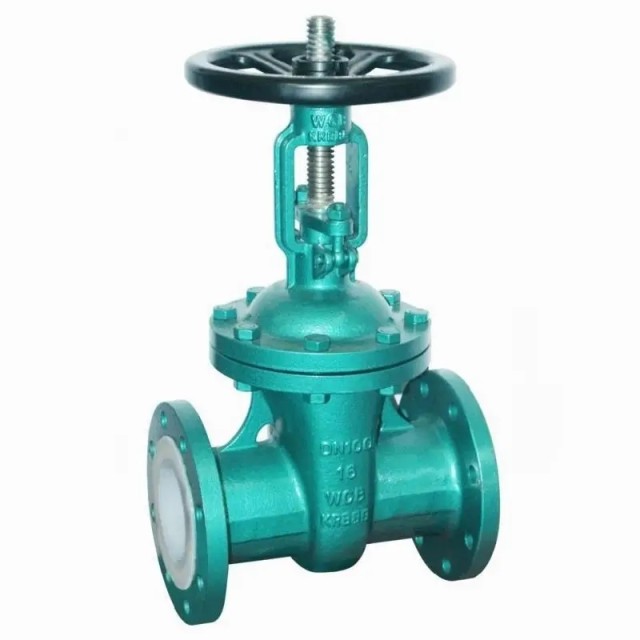
Fluorine-Lined Gate Valve

Fluorine-Lined Gate Valve

Working Principle:
The valve stem drives the gate to rise and fall vertically, controlling the flow of the pipeline; the medium only contacts the fluoroplastic lining layer and does not directly contact the metal valve body, completely isolating it from acid and alkali corrosion; it allows bidirectional flow without flow direction restriction, and is only used for switching off, not for throttling or regulating.

Product Description

Structural Features


1. Fully Fluorine-Lined for Corrosion Protection: The inner wall, gate, and seat are all lined with fluoropolymer, providing complete corrosion resistance and preventing media corrosion, rust, and leakage.

2. Minimal Flow Resistance: Straight-through design, large diameter, and low resistance, suitable for long-distance transport of corrosive fluids.

3. Excellent Sealing: Corrosion-resistant fluoroplastics combined with a soft seal ensure a tight, leak-free seal; wear-resistant, aging-resistant, and scale-free.

4. Robust Structure: The outer shell is made of cast steel/cast iron, providing high pressure resistance, while the inner fluoropolymer lining offers strong temperature and chemical resistance.

5. Easy Installation: Bidirectional flow, no installation direction requirements, flange connection, simple disassembly and maintenance.


Core Advantages


1. Resistant to strong acids, strong alkalis, strong oxidants, and organic solvents; extremely versatile.

2. Impermeable, corrosion-resistant, resistant to acids, alkalis, salts, and chemical solvents.

3. Media does not contact metal, extending the lifespan of valves and piping systems.

4. Fully open, non-erosion sealing surface; long service life.

5. No dead corners, less prone to material accumulation; suitable for corrosive wastewater and chemical liquids.

Materials and Parameters

• Valve body material: Cast iron, cast steel WCB

• Lining material: PTFE (F4), F46, PFA

• Pressure rating: PN10, PN16

• Applicable temperature: -20℃~180℃

• Connection method: Flange connection

• Drive method: Manual, electric, pneumatic


Applicable Media and Industries

Applicable media: Hydrochloric acid, sulfuric acid, nitric acid, liquid alkali, sodium hypochlorite, brine, corrosive wastewater, and various highly corrosive chemical fluids.

Application industries: corrosion-resistant pipelines in chemical, pharmaceutical, pesticide, electroplating, environmental desulfurization, wastewater treatment, pickling and phosphating, fine chemical and other industries.
Online Inquiry

Related Products

Gate Valve

Gate Valve

Working Principle: The medium flows in from below the valve seat, passes through the throttling gap between the valve disc and the valve seat, and flows out from the outlet. The valve disc stroke is controlled by the rise and fall of the valve stem, changing the flow cross-sectional area to achieve both shut-off and throttling. When closed, the axial pressure of the valve stem presses against the sealing surface to achieve a tight seal.

Structural Features:
1. Unidirectional Flow: Medium enters from a lower position and exits from a higher position; cannot be installed in reverse, requiring directional control during installation.

2. Good Sealing Performance: Plane/conical surface seal, tight closure, low leakage.

3. Excellent Throttling Performance: Controllable stroke, suitable for small-amplitude pressure and flow adjustment.

4. Relatively High Flow Resistance: S-shaped flow path in the pipeline, resistance coefficient higher than gate valves and ball valves.

5. Short opening and closing stroke, simple structure, convenient maintenance and replacement of parts.

Fluorine-Lined Gate Valve

Fluorine-Lined Gate Valve

Working Principle:
The valve stem drives the gate to rise and fall vertically, controlling the flow of the pipeline; the medium only contacts the fluoroplastic lining layer and does not directly contact the metal valve body, completely isolating it from acid and alkali corrosion; it allows bidirectional flow without flow direction restriction, and is only used for switching off, not for throttling or regulating.

Welding Gate Valve

Welding Gate Valve

Main Performance Parameters

• Nominal Pressure: PN16~PN160, complete high-pressure series

• Nominal Diameter: DN15~DN300

• Operating Temperature: -29℃~+425℃ (carbon steel); stainless steel and alloy steel are suitable for high-temperature conditions above 600℃

• Connection Method: Butt welding (BW), socket welding (SW), flangeless connection

• Sealing Form: Hard alloy seal, weld overlay seal, high sealing level, pressure and high temperature resistance

Structural Forms

1. Straight-through welded gate valve: Conventional and universal structure, widely applicable to most process pipelines.

2. Angle welded gate valve: 90° inlet and outlet layout, suitable for pipeline bends and compact equipment interface installation positions.

3. Y-type direct-flow welded gate valve: Smooth flow path, lower flow resistance, reducing media resistance and scouring losses.

Gate

Gate

Working Principle: The valve stem drives the gate to move vertically up and down. When the gate is fully raised, the pipeline is straight and flow is unimpeded; when the gate falls, it presses against the valve seat, blocking the flow of media.

The media can flow in both directions without directional restrictions, and there are no flow direction requirements during installation.

+86 19858780995

+86 19858780995

+86 19858780995

+86 19858780995

19858780995@163.com