
poster
HomeProductsKnife Gate ValvesPenetration-Type Knife Gate Valve (Two-Way Sealing)
Penetration-Type Knife Gate Valve (Two-Way Sealing)

Penetration-Type Knife Gate Valve (Two-Way Sealing)

Structural Features

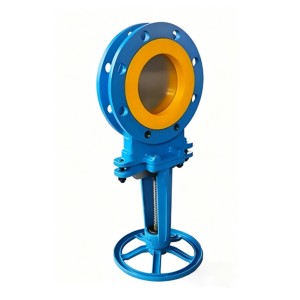
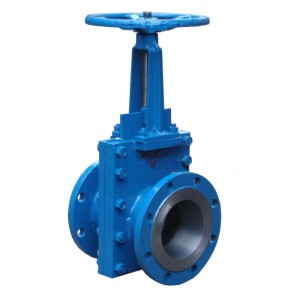
• The gate is longer than the valve body, allowing it to completely penetrate the valve body during opening and closing.

• It has a guide bracket at the top and generally an outlet cover/discharge port at the bottom.

• The gate operates more stably, without deviation or bending.

• Mostly wafer or flange type, providing greater overall rigidity.

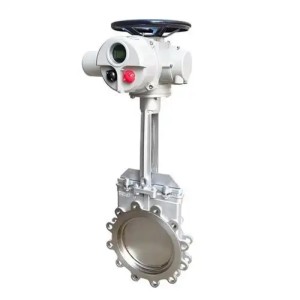
• Driven manually, pneumatically, or electrically.

Product Description

Core Advantages


1. No jamming or material accumulation: Debris is directly carried out of the valve body by the gate, preventing it from getting stuck at the bottom.

2. More reliable sealing: The gate is guided throughout its travel, ensuring a tight fit and significantly better shut-off performance than ordinary knife gate valves.

3. Wear-resistant and deformation-resistant: The long stroke and guide design prevent the gate from bending or breaking.

4. Easy to clean and maintain: The bottom can be opened to clean debris without disassembling the entire valve.


Applicable Operating Conditions


• Media: High-concentration slurry, mud, mineral slurry, coal slime, tailings, ash, sludge

• Industries: Mining, metallurgy, power plant ash removal, wastewater treatment, tailings transportation

• Features: Suitable for scenarios where media contain many particles, are prone to sedimentation, and where ordinary knife gate valves frequently jam.
Online Inquiry

Related Products

Polyurethane Knife Gate Valve

Polyurethane Knife Gate Valve

Core Structure

• Valve Body: Ductile iron/WCB, fully lined with polyurethane (PU)

• Gate: Stainless steel (304/316/2205) + polyurethane coating

• Sealing: Polyurethane seat (soft seal)

• Connection: Wafer type / Flange type

• Drive: Manual, pneumatic, electric, bevel gear

Penetration-Type Knife Gate Valve (Two-Way Sealing)

Penetration-Type Knife Gate Valve (Two-Way Sealing)

Structural Features

• The gate is longer than the valve body, allowing it to completely penetrate the valve body during opening and closing.

• It has a guide bracket at the top and generally an outlet cover/discharge port at the bottom.

• The gate operates more stably, without deviation or bending.

• Mostly wafer or flange type, providing greater overall rigidity.

• Driven manually, pneumatically, or electrically.

Ceramic Knife Gate Valve

Ceramic Knife Gate Valve

Ceramic knife gate valves (also known as ceramic knife-type gate valves) are special valves that combine a knife gate valve with a high-performance ceramic seal. The core seal and flow components are made of toughened alumina/silicon carbide ceramic, while the valve body is typically made of carbon steel (WCB) or stainless steel (304/316L).

Structure and Principle

• The opening and closing element is a knife-edged gate, moving perpendicular to the media flow direction, cutting media containing particles and fibers through shearing.

• The gate rises and falls within a side guide groove, and the bottom lug tightly presses against the valve seat, eliminating cavities, slag accumulation, and jamming.

• The valve seat commonly uses a protective lip ceramic ring + O-ring to achieve a bidirectional hard seal, with a leakage level reaching ANSI Class VI.

Concealed Plate Knife Gate Valve

Concealed Plate Knife Gate Valve

Structural Features

• Concealed valve stem: The drive screw is hidden inside the valve body/support, not exposed.

• The gate moves up and down within the valve cavity, resulting in a cleaner appearance.

• Generally a clamp-type connection, flange type is also available.

• Sealing is mostly soft seal (rubber) or hard metal seal.

• Drive methods include manual, pneumatic, and electric.

+86 19858780995

+86 19858780995

+86 19858780995

+86 19858780995

19858780995@163.com