poster
HomeProductsBall ValveFixed Ball Valve
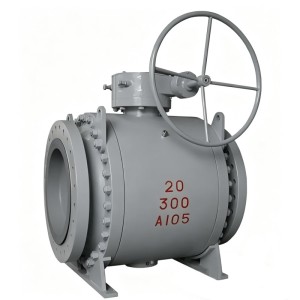
Fixed Ball Valve

Fixed Ball Valve

Structural Features

• The valve core is a fixed shaft structure, positioned by bearings/sleeves at the top and bottom.

• The valve core itself does not move back and forth; sealing is achieved by the valve seat pressing against the valve core.

• It is a bidirectional sealing structure.

• Common connections: flange connection, welded connection.

Product Description

Working Principle

1. Medium pressure prevents the valve core from pushing to one side, keeping it always centered.

2. Rotating the valve core 90° achieves full open/full close.

3. The valve seat has a built-in pre-tension spring, ensuring a seal even at low pressure.

4. More reliable sealing under high pressure, less prone to jamming and wear.


Main Advantages

1. Suitable for high pressure and large diameters. Pressures can reach Class 600, 900, 1500, and even higher. More stable than floating ball valves at large diameters.

2. Low torque and easy operation. The valve core is not pressurized, making manual/pneumatic/electric operation easier.

3. Long seal life. The valve core does not rub against or compress the valve seat, resulting in even wear, suitable for frequent switching.

4. Less prone to jamming. More durable than floating ball valves in media containing particles and impurities.

5. Optional bidirectional sealing. Achieves true bidirectional zero leakage, meeting the requirements of complex pipelines.


Applicable Operating Conditions

• Oil and gas, chemical, long-distance pipelines

• High temperature, high pressure, flammable and explosive media

• Large-diameter pipeline networks, circulation systems

• Media containing small amounts of particles, viscous media


Common Material Combinations

• Valve body: WCB/SS304/SS316/33316L/special alloy materials

• Valve core/seat: Hardened stainless steel/hard alloy overlay

• Seal: PTFE, filled PTFE, reinforced PTFE

• Applicable temperature: Approximately -29℃~200℃

Online Inquiry

Related Products

Eccentric Hemispherical Valve

Eccentric Hemispherical Valve

Structure and Principle

• The valve core is hemispherical, with its rotation center eccentric to the valve body center.

• When open: The hemisphere disengages from the valve seat, resulting in no friction and low torque.

• When closed: The hemisphere presses against the valve seat, forming a line/surface seal.

• Typical structures: Side-mounted/Top-mounted, eccentric shaft, eccentric hemisphere.

Fixed Ball Valve

Fixed Ball Valve

Structural Features

• The valve core is a fixed shaft structure, positioned by bearings/sleeves at the top and bottom.

• The valve core itself does not move back and forth; sealing is achieved by the valve seat pressing against the valve core.

• It is a bidirectional sealing structure.

• Common connections: flange connection, welded connection.

Fluorine-Lined Ball Valve

Fluorine-Lined Ball Valve

Structural Features

• Valve body is generally made of carbon steel or stainless steel, with the inner wall entirely lined with PTFE.

• Common lining materials: F4 (PTFE), F46, PFA, PO, etc.

• The ball is also PTFE-coated/lined for full-flow-channel corrosion protection.

• The structure is mostly a floating ball, with flange connections as the primary method.

• The sealing surface has inherent corrosion-resistant and anti-stick properties.

Pneumatic Floating Ball Valve

Pneumatic Floating Ball Valve

Structural Features

• The ball has no lower support shaft; it is held only by the valve seats at both ends, allowing for slight floating under medium pressure.

• The valve stem is top-mounted, connecting to the ball, and is only responsible for rotation, not bearing axial pressure.

• Double-sided sealing: When closed, the ball is pushed towards the outlet valve seat by the medium pressure, forming a self-tightening seal.

• Simple structure: The valve body, ball, valve seat, valve stem, and stuffing box have few components, making maintenance convenient.

Working Principle

• Opening: Rotate the valve stem 90°, aligning the ball's through-hole with the pipeline, allowing smooth media flow.

• Closing: Rotate the valve stem 90° in the opposite direction, aligning the ball's through-hole perpendicular to the flow path; media pressure pushes the ball tightly against the outlet valve seat, with a tighter seal at higher pressures.

+86 19858780995

+86 19858780995

+86 19858780995

+86 19858780995

19858780995@163.com