
poster
HomeProductsBall ValvePneumatic Floating Ball Valve
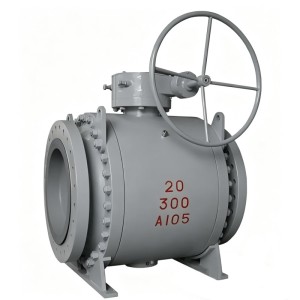
Pneumatic Floating Ball Valve

Pneumatic Floating Ball Valve

Structural Features

• The ball has no lower support shaft; it is held only by the valve seats at both ends, allowing for slight floating under medium pressure.

• The valve stem is top-mounted, connecting to the ball, and is only responsible for rotation, not bearing axial pressure.

• Double-sided sealing: When closed, the ball is pushed towards the outlet valve seat by the medium pressure, forming a self-tightening seal.

• Simple structure: The valve body, ball, valve seat, valve stem, and stuffing box have few components, making maintenance convenient.

Working Principle

• Opening: Rotate the valve stem 90°, aligning the ball's through-hole with the pipeline, allowing smooth media flow.

• Closing: Rotate the valve stem 90° in the opposite direction, aligning the ball's through-hole perpendicular to the flow path; media pressure pushes the ball tightly against the outlet valve seat, with a tighter seal at higher pressures.

Product Description

Performance Parameters

• Nominal Diameter: 1/2"~8"

• Nominal Pressure: Class 150

• Valve Body Material: Carbon Steel (WCB), Stainless Steel (304/316), Special Alloy Materials

• Sealing Material: PTFE, PEEK, Metal Seals


Main Advantages

• Quick Opening and Closing: Fully open and close with a 90° rotation.

• Minimal Flow Resistance: Full-bore design with virtually no media loss.

• Reliable Sealing: Pressure self-tightening; the higher the pressure, the better the seal.

• Compact Size and Light Weight: Easy installation and maintenance.

• Low Cost: Simple structure, lower cost than fixed ball valves.


Applicable Scenarios

• General industrial pipelines: water supply and drainage, HVAC, chemical, petroleum, natural gas, power

• Applicable media: water, steam, oil, gas, acids and alkalis, some corrosive media
Online Inquiry

Related Products

3 PIECE BALL VALVE

3 PIECE BALL VALVE

Structural Features

• The valve body is composed of three forged steel pieces bolted together.

• The valve core, seat, and seals are all housed in the middle valve body section.

• Common connection methods: threaded (NPT/BSP), welded, quick-connect.

• Generally small diameter: mainly DN6~DN100.

• Mostly floating ball structure, reliable sealing, and compact size.

Ceramic Ball Valve

Ceramic Ball Valve

Key Features:

1. Superior Corrosion Resistance: Zirconia/alumina ceramics are resistant to almost all acid, alkali, and salt media, and do not rust or corrode.

2. Ultra-High Wear and Erosion Resistance: The high hardness of the ceramic means it experiences almost no wear under particulate media and slurry erosion, resulting in a lifespan far exceeding that of stainless steel.

3. Stable Sealing and Non-Stuck-Up: The smooth ceramic surface does not scale or adhere, ensuring stable switching torque and preventing jamming.

4. Zero Leakage: Precision ceramic mating seals enable bidirectional sealing.

5. No Media Contamination: The ceramic's high inertness prevents metal ion precipitation, making it suitable for high-purity and clean environments.

Disadvantages: Relatively brittle, not resistant to severe impacts or sudden temperature changes; careful selection and installation are required.

Eccentric Hemispherical Valve

Eccentric Hemispherical Valve

Structure and Principle

• The valve core is hemispherical, with its rotation center eccentric to the valve body center.

• When open: The hemisphere disengages from the valve seat, resulting in no friction and low torque.

• When closed: The hemisphere presses against the valve seat, forming a line/surface seal.

• Typical structures: Side-mounted/Top-mounted, eccentric shaft, eccentric hemisphere.

Forged Steel Ball Valve

Forged Steel Ball Valve

Key Features

• High-Strength Material: Forging process removes porosity and looseness, resulting in dense grains, high tensile strength, and superior wear resistance compared to cast steel.

• Reliable Sealing: Soft seal (reinforced PTFE/PPL) or hard seal (metal-to-metal), supporting double sealing, fireproof and anti-static.

• Stable Structure: Available in two-piece/three-piece flange connections, fixed ball or floating ball structure, and a split valve body for easy maintenance.

• Highly Efficient Opening and Closing: 90° rotation, low torque, fast opening and closing, suitable for frequent operation.

• Wide Temperature and Pressure Compatibility: Temperature range from -196℃ to 450℃, pressure rating from Class 150 to 1500.

+86 19858780995

+86 19858780995

+86 19858780995

+86 19858780995

19858780995@163.com